Eris Drew and Octo Octa bring pastoralism to big beat on Alchemical Sisters
The FADER spoke with half of the queer electronic duo about the recording their dancefloor-ready debut in rural New Hampshire.


 Alchemical Sisters.
Paola Salviano / via the artist
If you love vinyl records, raving into the early morning, and Queer people, the names Eris Drew and Octo Octa are very familiar. For the uninitiated, Eris and Maya are the vinyl maestros behind some of the most ecstatic, love-filled, imaginative, and technically ambitious DJ sets you’ll ever hear on the dance floor. The romantic and creative partners have been criss-crossing the globe for years deejaying both independently and together, and now they’ve released a new album under the name Alchemical Sisters.
As big beat fans might surmise, the duo’s moniker is a bit of a nod to The Chemical Brothers. “At first it was a wink, but the name stuck,” says Eris. “It seemed right because we felt that, through alchemy, something higher would emerge when we got together—our individuality combining to make a little musical baby.”

Read Next: Listen to a new FADER Mix by Octo Octa
When I ask about the pair’s musical inspirations, they cite Underworld, Meat Beat Manifesto, the Bassbin Twins, and Hardfloor. But they seem even more inspired by the literal act of recording, telling me that the best songs come from artists taking the time to chase down their errant ideas until something timeless emerges from the creative process. “You see people at their final moment,” Eris reflects. “They’ve worked for ten years to become a great DJ, and it seems like it happened overnight – but usually it didn’t.”
Alchemical Sisters’s self-titled album, released October 19 on Interdimensional Transmissions, feels effortlessly timeless, spanning various moods and relations yet still contained within Eris and Maya’s own constructed universe. Each track speaks in its own form, yet the language of the album is unifying in its effect. From higher-energy tracks like “Anytime Sisters Slide” (my favorite) to those grounded in calmness such as “Song For New Hampshire," each one exists in a space constructed so specifically to the tastes of its creators: the warmth and joy that characterize the duo’s back-to-backs, that pervade the connection between themselves and others, have now made it into the form of a traditional hardware instrument album, which has a danceability that cannot be overstated. I listened to it in full for the first time biking home from the FADER HQ. The groove – namely big beat, breaks, and acid – was so potent that I almost fell off my Citi Bike.
The FADER recently caught up with Eris over the phone, while she and Maya were on the road in the Netherlands, to chat about working with your life partner and recording Alchemical Sisters.
The FADER: What was the moment of conception for Alchemical Sisters?
Eris: A few years ago, Special Interest asked us to do a remix of one of their songs. Maya and I had been a DJ duo for a long time, and had talked about making music together, but that really stimulated us to do it – and to do it on a tight timeline.
It was really cool because they’re a queer punk band, so we had unique material to work with. It wasn’t just the stuff you’d find in a standard dance track: there were vocals, drums, and guitars. Maya and I had been sharing a lot of music from the classic big beat era, which is some of the only dance music that incorporates real drums and guitars, and has more of a rock-and-roll vibe. We thought the remix pushed us to do something we’d wanted to do anyway.
We took some mushrooms and spent four days working on it – which is a very short time for us to turn something like that around. But our remix for Special Interest was what got us going. We felt like we had a sound, an approach, and thought it would be really cool to work toward recording an album.
How did living in a cabin in New Hampshire inform the sound of this album?
It creates a contrast with our lives as touring artists, because we spend so much time in cities, airports, clubs, and other pretty intense spaces. When we go into the forest, it’s a lower-frequency space. We get to be intimate with each other, spend time in nature, cook, play games, and calm down.
We recorded most of the album over the winter, during those cold months in New Hampshire — the mix of ice and snow. We have so much equipment, and we needed somewhere to record it, so we did it in our master bedroom. We could put both of our setups in the same room and look out the big windows at the icy landscape.
There was the serenity of that, mixed with the charged inspiration of being DJs and working in dance music. To put it in one sentence: living and working in the cabin in New Hampshire injects a kind of pastoralism into music where you don’t usually hear it. Some of the more beautiful moments on the record contrast with the heavier moments. Those are very much cabin motifs.
There’s a whole song dedicated to New Hampshire, which is arguably the calmest one.
When Maya plays dulcimer in the house, it signals to me that we’ve entered a different way of being. You really can’t bring a dulcimer on the road. We could never have recorded that song in a hotel room or something.
When I hear her playing that instrument, it means we’re home – really home. So we made a song around that, because at its heart it’s just a dulcimer dirge.
What speaks to you most about collaborating musically with your life partner?
At the simplest level, we work differently. She brings something to the music that I can’t, and vice versa. That’s part of why we wanted to name the project Alchemical Sisters: it’s about our sisterhood and friendship, too. In alchemy, you turn lead into gold by combining it with something else. It’s the idea that the result is more than the sum of its parts.
It was interesting to do this at first because Maya and I have a beautiful relationship and a wonderful home life. We tour the world, back-to-back, and do all these things together, but we’d never made music together. And it is hard to make music with someone. With very few exceptions, Maya and I had mostly worked by ourselves.
We wondered whether the magic that seems to infuse everything else we do would make its way into the music, or whether it would be difficult. Our differences actually present challenges. Now that we’ve done it, I can look back and say, “Well, of course—it’s like everything else we do.” But when we started, I was nervous: Can we do this together, too? Making original music together is a real act of trust and of believing in each other.
To my knowledge, this album was mostly created with analog synths and the like. What makes that process unique from working in a DAW, like Ableton?
We tend to use the word “traditional” for hardware instruments, because some of those instruments are digital. We use a lot of ’90s digital instruments and stuff like that. There were a lot of filters and units, some of which were digital.
We wrote outside of the DAW, but then recorded everything multi-tracked into a DAW. So a DAW was still part of the process: we used it more like a traditional tape recorder would have been used in a studio, like an eight-track, rather than doing our writing in the DAW.
One of the simplest things is that you can’t use two mice on a DAW, right? Maya and I could each have our own setup, just like a band. The left side of the studio was all her stuff, and then we put a computer between us. Once we felt like we had something pretty much written, we started recording those parts as performances into the DAW. That let us mix it later and do overdubbing – adding other things here and there, and sometimes changing the arrangement.
On the one hand, it was cool because it felt much more like being in a band. We each had our own setup and could riff off each other. On “We’ve Seen Great Power,” for example, I’ve got an MPC with a harmonica sample and another sample on it. Maya has a Roland 606, which she runs through a machine called a Sherman Filterbank. It takes the sound and processes it. She’s to my right, and we’re looking at each other and jamming in real time. You can’t do quite the same thing with a computer. Jamming like a band and writing that way meant we weren’t just staring at things visually and asking, “Okay, what’s next?” It all kind of happened at once.
There’s also something about using what we called “ancestral instruments” in the write-up. What we meant was instruments that have been used by thousands of people. They have all this life energy – almost like folk instruments. Think about how many people have put a Roland 808 in a song: tens of thousands. You might think, “Maybe I should do something else,” but those instruments also give a track a certain power and feeling.
As cool as it is to use samples of an 808 or 909, Maya actually owns those instruments. We had classic dance-music instruments right there. It’s wild to create something that feels original with something that’s been used so much. It’s like a guitarist developing their own way of playing: millions of people play guitar, but they’re not all going to sound the same.
There’s something cool about having physical instruments and knowing they have lineages. One of the 303s we had came from a really respected queer artist from Texas. He was selling it and noted in the listing that it didn’t sound like other 303s. Over time, the circuits drift and age, and that gives the instrument character.
Bill’s 303 has its own character. It has a crazy tone to it, almost like an insect swarm. It was really cool to make our music—which doesn’t sound anything like Bill’s music—on Bill’s 303. Knowing that another queer person had made special music with it gave us a sense of a river of time, like inheriting a quilt from your grandma. You can’t get that with a program you download online.
Are there any tracks on the album that you feel particularly respond to each other or are in conversation with one another?
Two that come to mind are “We’ve Seen Great Power” and “Why Not Dream?” “We’ve Seen Great Power” is the second track. The voice at the beginning is a famous singer from the ’60s being interviewed. She’s asked about the hippie movement and whether society is going to change in response to what young people want. She says, essentially, “Yeah, but there’s always going to be a whole big group of straight people who aren’t going for it.”
We put that near the beginning because it acknowledges a very real truth: there’s tremendous pushback against trans liberation, queer liberation, freedom, personal dignity, peace, and treating the world well. “Why Not Dream?” is basically saying that we have to keep our dreams alive and keep dreaming collectively. We have to think about our future, or other people will write it for us—and they’re not going for it.
So it’s up to all of us to continue dreaming. I think those songs really speak to each other. The reason it’s called “We’ve Seen Great Power” is that, even though these people think they can control us and have all the answers, we’ve pierced the veil. As queer and trans people, we see the world differently.
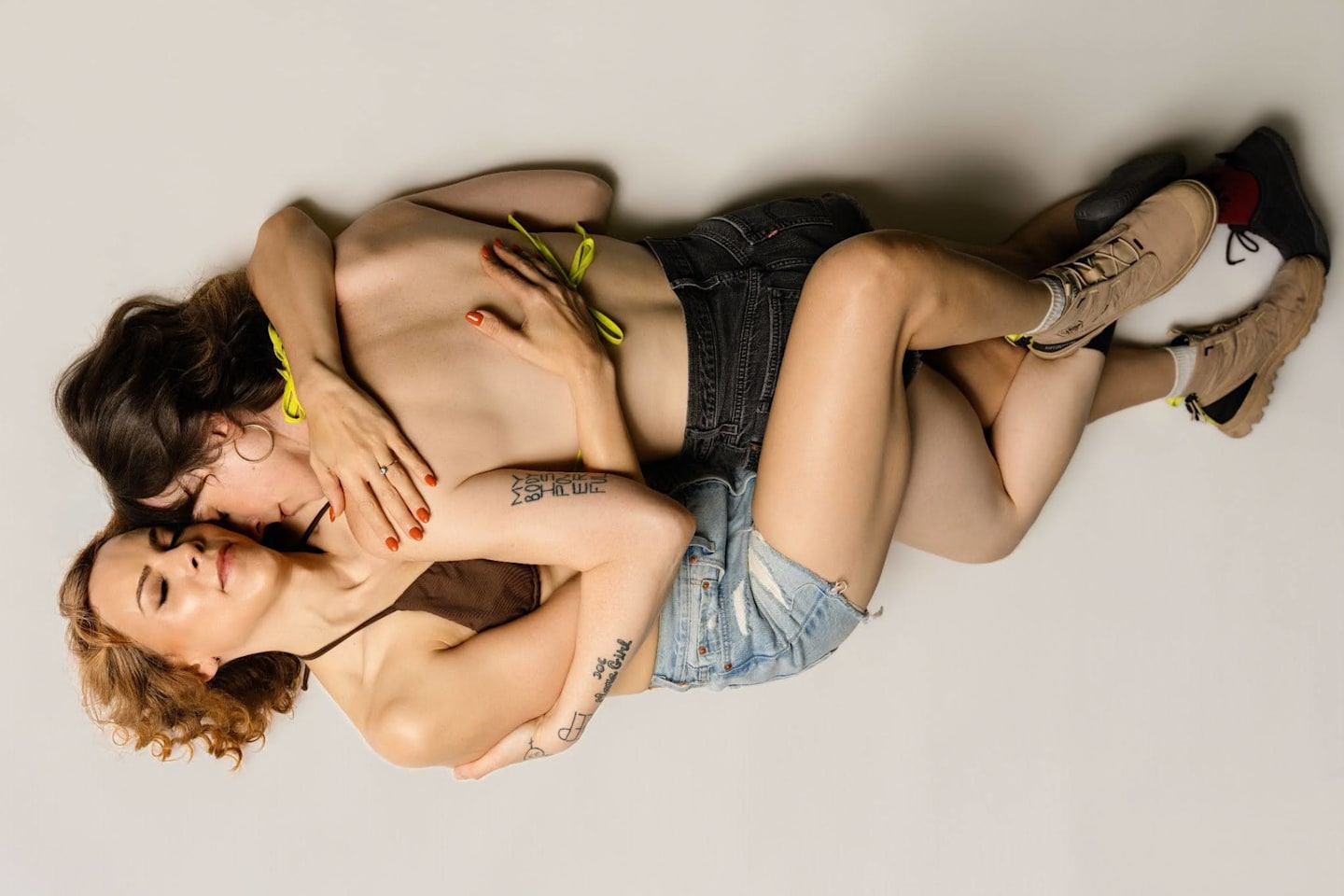 Paola Salviano / via the artist